
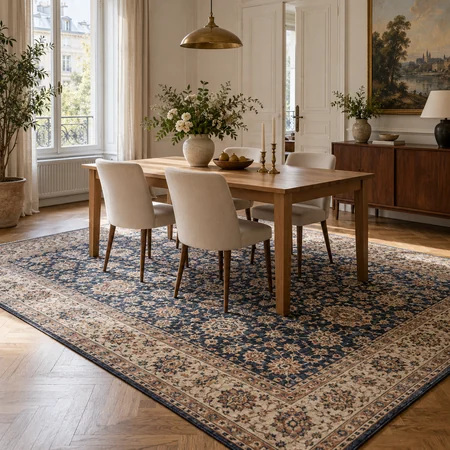
A Persian rug for a dining room should be large enough for the table and for the chairs as people sit down and stand up. Measure how far the back legs travel when someone gets up comfortably. Use that measurement to work out the rug width and length, then check separately that there is still room to walk past the table.
Take these measurements before comparing patterns. A rug can look generous when all the chairs are tucked in and still be too small at mealtimes. Testing the layout with your own furniture gives you a size range you can use while shopping.
Measure how far the chairs move
Put the table where you plan to use it. If it extends, decide which arrangement the rug needs to accommodate. You may want it to fit the everyday layout, or you may need room for guests at both ends when the table is extended. Measure both layouts if you regularly use both.
Sit down and stand up as you normally would. Ask someone to mark the furthest position of the back feet with a floor-safe marker. Measure from the tabletop edge to that point. Repeat on the opposite side and at each occupied end. Armchairs, benches and chairs with angled legs can take up different amounts of space, so record the four sides separately.
Allow some rug surface beyond the furthest chair position so the back feet land clear of the binding. Use your trial to decide how much extra room you need. Count the usable rug body in this measurement. Keep fringe clear of moving chair feet and busy routes through the room.
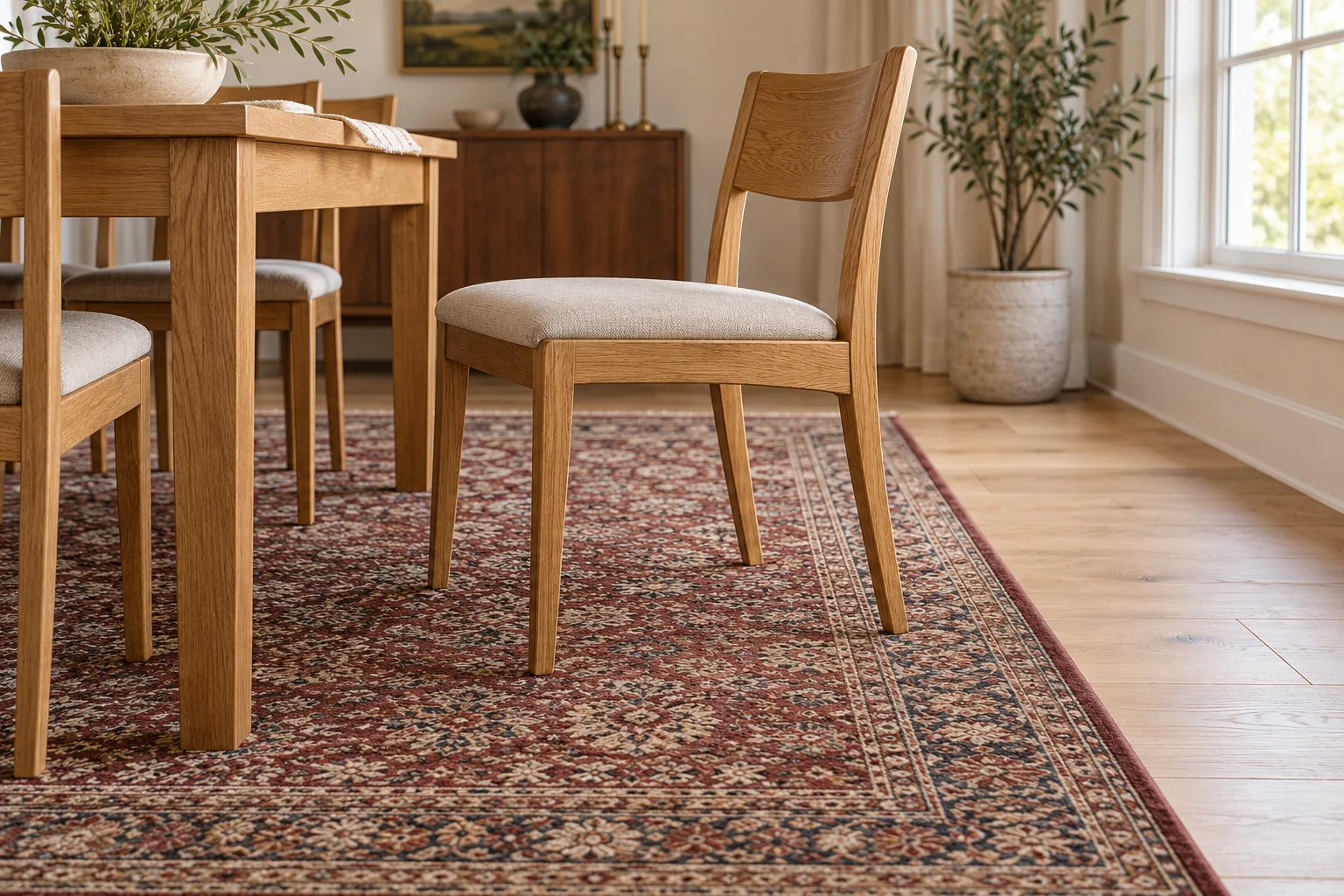
Worked example for a rectangular table
Suppose the table is 90 × 160 cm. In your trial, the back legs reach 65 cm past the tabletop edge on every side, and you want another 10 cm of rug behind them. That gives you 75 cm per side in this example. Use your own measurements when applying the calculation.
| Direction | Calculation | Rug size in this example |
|---|---|---|
| Width | 90 + 75 + 75 cm | 240 cm |
| Length | 160 + 75 + 75 cm | 310 cm |
A 200 × 300 cm rug would be 40 cm too narrow and 10 cm too short for that layout, even if the table and tucked-in chairs fitted. A rug measuring at least 240 × 310 cm across the usable surface would meet the calculated minimum, provided the room can accommodate it. Check the actual measurements of the specific handmade rug you are considering.
If you normally seat people only along the long sides, use the clearance you actually need at each end. Try the arrangement with an extra chair before deciding. An end seat that appears only when the table extends can affect both the rug length and access to the room.
Check the space people need to walk past
Chair movement and walking space are two separate measurements. Ask someone to sit at the table while you walk behind them. Try the routes to the kitchen, the doorway and the sideboard. Open nearby cabinet doors and pull out drawers to see whether the arrangement works during a meal.
Mark the proposed rug outline with sheets of paper or a floor-safe marker during the trial. Remove loose markers when you finish. If the outline leaves too little room at a doorway or sideboard, try moving the table and measure again. The largest rug you can fit comfortably in the room is your upper limit.
Check which parts of the pattern will show
The tabletop often hides much of a central medallion. Look at the parts of the rug you will see from the doorway and from the chairs. A broad border can frame the table, while an all-over design can keep the visible sections looking balanced when the middle is covered.
When comparing hand-knotted Persian rugs, look at a photograph of the whole piece and imagine the table placed over it. The border, chair upholstery and exposed floor will make up much of the view.
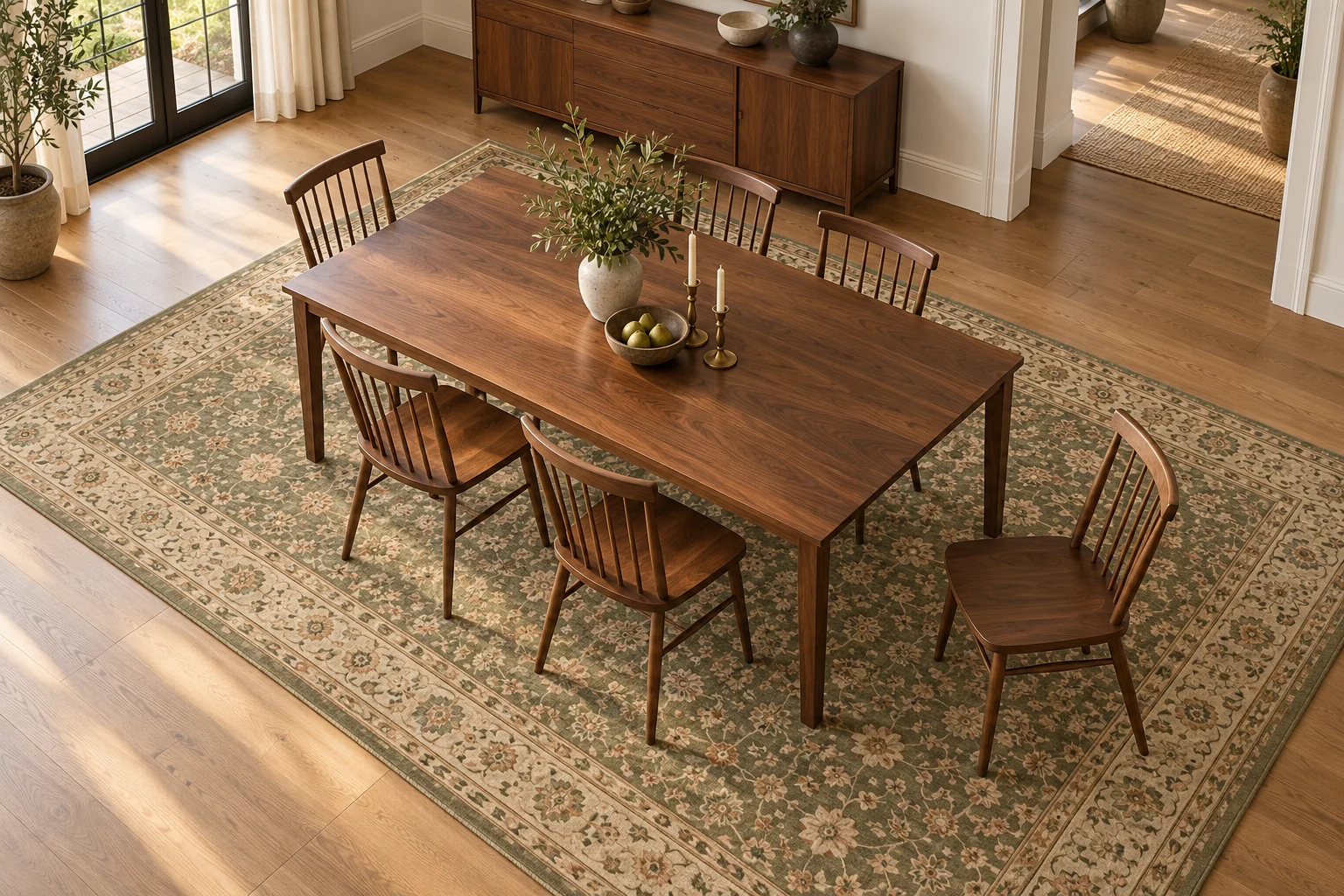
Consider everyday wear and care
Dining chairs move repeatedly across the same areas, and food or drink can spill. Check the rug’s material, condition and care instructions together. If you are considering a delicate piece, ask how it will suit the way you use the room. Check that the chair feet are smooth and intact.
Follow the care instructions for the individual rug. If a drink spills, blot gently with a clean absorbent cloth. Ask for specialist advice before further treatment if you are unsure about the fibre or whether the dyes are colourfast.
Keep a measurement sheet for ordering
- Record the width and length of the table in its everyday and extended positions.
- Mark every side where a chair is used, including occasional seats.
- Write down the furthest position of the back chair feet and the extra rug surface you need behind them.
- Sketch doors, cabinets and walking routes. Record the largest rug outline that leaves these usable.
- Compare the usable dimensions of the rug with your minimum and maximum measurements. Check how the seller measures the fringe.
If your minimum is larger than the room allows, test a different table position or seating arrangement before you order. Keep the everyday and extended layouts on separate sketches so you can see which one sets the limit.
For more on weighing up a rug in your own home, read our guide to choosing a rug when shopping online.
Frequently asked questions
Is it enough for the chairs to fit when pushed in?
Check them when pulled out as well. The back feet should stay on the usable rug surface as someone sits down or stands up. Test this with your own chairs.
Do I need the same allowance on every side?
Measure each side according to how you use it. A frequently used end seat may need a different allowance from a side that is usually empty.
Does the listed size include the fringe?
Confirm how the specific rug was measured before ordering. Base your chair-clearance calculation on the rug body and account for the fringe when you mark the full outline.
What if the required rug size is too large for the room?
Try a different table position and check the walking routes again. A smaller rug can work if your trial shows that the chairs still move comfortably on its usable surface.